ZX Spectrum guide
The ZX Spectrum Next Explained
The Spectrum Next is a modern computer that recreates the Spectrum's hardware and adds faster speeds, new graphics and an SD card. Here is what it is and who it's for.
In short
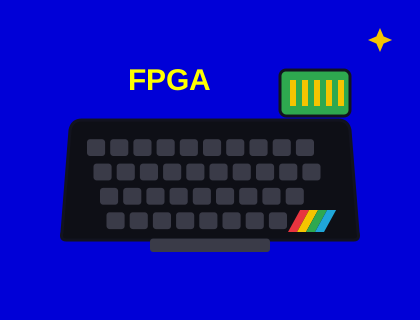
- The ZX Spectrum Next is an enhanced Spectrum built on an FPGA chip, which recreates the hardware rather than emulating it in software.
- It runs original 48K, 128K and +3 software and has its own enhanced mode with faster speeds and more colours.
- It has been crowdfunded on Kickstarter three times; the third campaign, for Issue 3, ran in July 2025.
- Its case was designed by Rick Dickinson, who designed the original Spectrum.
- It suits enthusiasts and developers more than casual players.
What is the ZX Spectrum Next?
The Next is a new computer designed to be what the Spectrum might have become. It behaves like a real Spectrum at the hardware level, so original software runs on it, but it can also switch on a range of improvements: a faster processor, extra graphics modes and hardware sprites, more memory, and modern storage and video.
The case, in black with the familiar rainbow stripe, is by Rick Dickinson, the industrial designer of the original Spectrum, who died in 2018.
FPGA: why it's different from an emulator
An emulator is a program that imitates a computer. An FPGA (field-programmable gate array) is a chip that can be configured to become a circuit. The Next's FPGA is set up to act like the Spectrum's own chips, working at the same moments the originals would. That gives it very high compatibility with timing-sensitive games and demos, and means it works with many original peripherals through its expansion port.
What it adds to the Spectrum
- A Z80-compatible processor that can run at several times the original speed, with extra instructions.
- New graphics modes with more colours, hardware sprites and smooth scrolling, alongside the original screen.
- Extra memory and an SD card instead of tapes, although it can still load from cassette.
- HDMI and VGA video output, two 9-pin joystick ports, and Wi-Fi.
- Its own library of new games and programs written to use the enhanced modes.
A short history of the Next
The Next began as a community project to build the Spectrum its fans had imagined. Its first Kickstarter campaign raised over £700,000, and the first machines reached backers in 2020 after a long development period, slowed partly by the work of building cases and keyboards to a high standard. Since then the project has grown a library of new software and an active community of developers.
Issue 2 and Issue 3
The first Next machines reached backers in 2020. A second Kickstarter produced the Issue 2 boards. The third campaign, for Issue 3, went live on 19 July 2025 and raised around £2.6 million, far beyond its target. Issue 3 uses a larger FPGA, which lets it also run extra "cores" that turn it into other computers, including a Sinclair QL and a Commodore 64. Its makers described it as probably the last chance to buy one.
Availability changes. The Next has been sold mainly through Kickstarter rather than in shops, so check the official SpecNext website for how to get one now, and be careful with second-hand listings at very high prices.
What can you run on a Next?
| Software | Runs? | Notes |
|---|---|---|
| Original 48K and 128K games | Yes | From tape files on the SD card, or from a real cassette |
| +3 disk software | Yes | The Next can behave like a +3 |
| Next-only games and programs | Yes | Written to use the faster processor, extra colours and sprites |
| Other computers | Issue 3 | Extra cores, such as the Sinclair QL and Commodore 64, were part of the Issue 3 campaign |
Things to know before you buy
- It's not a shop product. The Next has mainly been sold to Kickstarter backers, with occasional sales through the official site. Delivery dates for crowdfunded hardware can move.
- Check what's included. Campaigns have offered different packages, including bare boards, cased machines and accelerated versions.
- Second-hand prices vary widely. Compare several listings, and make sure the case, keyboard and any upgrades are what the seller says.
- Set aside time to tinker. Much of the fun of the Next is in its menus, settings and software library.
Is the Next right for you?
The Next is ideal if you want real hardware, enjoy tinkering, or want to write new software, including for its enhanced modes. It's more expensive than The Spectrum, and much of what makes it special is for enthusiasts. If you mainly want to play classic games on the TV, The Spectrum is simpler; if you want the original article, see buying an original Spectrum.
Do our games run on the Next?
Our games are standard 48K and 128K Spectrum programs, written to run on original hardware, so they're the kind of software the Next is built to run. You can play them now in the arcade. Thinking of writing your own? Our guide to writing a ZX Spectrum game lists emulators, such as ZEsarUX, that also emulate the Next. And for the bigger picture, read the history of the Spectrum.
Questions and answers
What is the difference between The Spectrum and the Spectrum Next?
The Spectrum is a full-size 48K replica that emulates the hardware in software and plugs into a TV. The Spectrum Next is an FPGA machine that recreates the hardware and adds faster speeds, new graphics modes and an SD card. See the Spectrum Next explained.